Why Housekeeping Room Management for Small Hotels Is Still on Paper
Here is a question worth asking: right now, can your whole team see the same floor? You, your supervisor, and your front desk, seeing the same rooms, the same thing, at the same time?
Not a general idea, or what the morning report said three hours ago. Right now.?
For most independent and small hotel operators, the honest answer is no. And that gap, between what your team knows and what you know, is where guest complaints are born, check-ins get delayed, and productivity takes a hit nobody can explain at the end of the shift.
Without knowing what is happening on your floor, your supervisor can be spending half their time chasing status updates, and your front desk is guessing which rooms are ready.

Small hotels are often choosing between two extremes: keep managing the floor with paper, spreadsheets, and text messages, or invest in a larger system that may be too expensive, too complicated, or more than the property actually needs.
By the end of this article, you will know about QBoard. It’s a room management tool we built specifically to sit in that gap. It gives small hospitality teams a simple, real-time room status board that can be accessed from any browser, designed to reduce missed updates, delayed communication, and confusion throughout the day.
That said, whether you’re using a clipboard, a spreadsheet, or something purpose-built, we always say that the principles matter more than any single tool. Let’s take a closer look at how small hotels are still operating today.
What Room Management Actually Means
A good definition of room management could be; it is the system that coordinates
people, resources, and tasks to keep every room moving through daily turnover, so it’s
ready to receive the next guest.
In plain operator language, at its core, room management means three things: knowing the status of every room, knowing who is responsible for it, and knowing where it is in the process at any given moment.
In a large branded property, most of the time, this is handled through a Property Management System with a housekeeping module, where managers control the room flow, room attendants get assignment sheets or a mobile device with an app, inspectors sign off digitally, and front desk sees room availability update in real time. The whole operation runs on shared, live information, in a fully connected system.
But What Do You Actually Have
Room Management for Small Hotels, can have different strcuture. When you are the general manager, Front Desk, sometimes the one stripping beds on a sold-out Saturday, and the one cleaning or inspecting the rooms yourself, you already know the status of every room, because you are everything, and the one touching them.
But the moment your operation grows a bit larger, one that might include room attendants, a supervisor, and an active front desk checking guests in, everything changes. That’s when you start to feel the need for information and updates from the floor.
So what fills the gap? Usually a combination of handwritten lists, radio calls, text messages, and someone walking the floor every 20 minutes to check on things. It works until it does not. And on a busy early arrival holiday Friday, with a 45 rooms flip, it usually does not.
The question is not whether you need a room management system, because you already have one. The question is whether the one you have is working for you or against you.
Why Room Management for Small Hotels Got Left Behind
The hospitality technology market has grown significantly over the last decade. Property Management Systems, channel managers, revenue management tools, guest messaging platforms. The options are endless. But look closely at who those tools are normally built for.
Most housekeeping and room management modules are add-ons to enterprise PMS platforms that start at several hundreds of dollars a month before you even add the housekeeping feature. Implementation requires training, onboarding, and sometimes a dedicated support contract. The sales process alone assumes you have a general manager with time to evaluate software and an IT staff to handle the setup, (including systems integrations and upgrades in most cases).

I am almost sure that “more” time is the one thing you do not have; and after researching what is available in the market, you found the systems exist, but they were designed for properties three times your size, priced accordingly, with too many features you would pay for but never use, and requiring a level of technical setup that most small hotels simply do not have the time, staff, or budget to manage.
Most of the tools that do exist for smaller properties tend to be watered-down versions of enterprise software: still complex, still expensive relative to the value they deliver, and still not built from the floor up for a 30-room property running lean. That is not a criticism of those products. It is just an honest observation about where the market focused its attention. Large hotels have more rooms, more revenue, and more budget. The technology followed the money.
Independent small hotel operators have built workarounds. And those workarounds became the standard.
What Operators Are Actually Doing
I spend time in the forums, Facebook groups, and Reddit threads where independent hotel operators talk to each other, and you see the same conversations playing out over and over. How do you track which rooms are ready or how many attendants are on schedule? How do you communicate room status to the front desk without calling them every twenty minutes?
The answers are remarkably consistent. A whiteboard in the housekeeping office. A printed room list with handwritten status updates. A group text thread between the supervisor and front desk. Someone physically walking the floor and reporting back.
These are not bad solutions. They are resourceful solutions built by operators who had no better option available at a price and complexity level that made sense for their property. But they share a common limitation. The information lives in one place, with one person, at one moment in time. The moment that person moves, takes a call, or steps away, the picture goes stale.
The Productivity Question Nobody Is Asking
How long did it take to clean that room? Which attendant is consistently finishing on time, and which one is falling behind? What is the status of each room right now?
Without a live system, those questions are almost impossible to answer accurately. A supervisor can walk the floor and get a snapshot. A manager can review end-of-day numbers. But by the time that information is collected, organized, and reviewed, the shift is already over and the opportunity to correct course is gone.
What about your budget? How much does it cost for one room to be ready? How does that translate to your profits? Productivity in housekeeping is not just about speed. It is about visibility and effectiveness. You cannot improve what you cannot see, and you cannot see what is not being tracked.
What About Contracted Cleaning Services?
If your housekeeping is handled by a contracted cleaning service, the visibility gap gets wider.
You are now relying on an external team to self-report their progress, communicate room status back to your front desk, and flag any issues they find along the way. Without a shared, live system that your contracted team can also access, you are essentially managing blind.

You know when they arrived and you know when they left. Everything in between is a question mark. That uncertainty has a cost, in delayed check-ins, in guest complaints, in supervisors pulled away from their real job to answer questions that a good system would answer automatically.
What a Simple System Looks Like
You do not need enterprise software to run a tighter housekeeping operation. Before any tool or technology, the principles matter more than the platform.
Communication First
A functional room management system starts with shared, current information across your team. Your front desk should not have to call housekeeping to find out if room 204 is ready. That information should be available the moment it changes.
Every room needs an owner, because no room is going to clean itself. If a room has no assigned attendant, it has no accountability. And status needs to flow in real time, from the floor to the supervisor to the front desk.
Productivity Next
The second layer is data. How long did each room take? Which rooms consistently run long? Who on your team is your strongest performer, and who needs support?
That information lives in your operation right now. Most properties just have no way to surface it. A system that tracks time automatically, logs every status change, and gives you a daily report without extra work changes what you can see and what you can act on.
These principles work whether you are using a clipboard, a spreadsheet, or a purpose-built tool. The difference is how much manual effort it takes to keep things current, and how many people on your team can see the same picture at the same time.
Introducing QBoard

If you have been following Small Hospitality, you know we build tools for independent operators. Everything we put out comes from real operational experience and from what operators, like you, tell us they need.
We built a solution for this problem, and it started as a pattern, not a product idea. Small hotel operators, facing the same visibility gaps, and getting the same answer from the market: sorry, that tool does not exist at your price point or for your ammount of rooms.
So we built it.
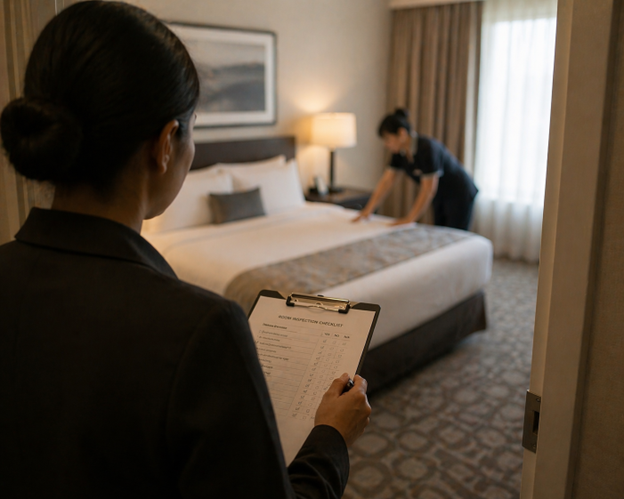
We designed QBoard as a live room status board specifically for small independent hotels. Your whole team works from the same board in real time. Room attendants see their assignments and update status from their phone. Supervisors assign rooms, run inspections, and monitor progress across the floor. Front desk sees room availability the moment it changes. Management reads productivity, cleaning times, and staff performance without chasing anyone down.
Watch a quick walkthrough on how QBoard works, from morning room assignments to final inspection. Watch Here
No complex setup and no confusing licensing, designed around what you actually need and what you can realistically afford as an independent operator.
Try QBoard free for 30 days. No commitment, no credit card. We set up your board and have it ready for your property within 24 hours.
Your Floor, Your System
Room management is one of those operational fundamentals that does not get enough attention until something goes wrong. When a guest is waiting at the front desk, your supervisor is running the floor instead of managing it, and your room attendant is unsure of their next assignment, your operation feels it, and the entire shift slows down.
The good news is the fix is not complicated. It starts with visibility. When your whole team sees the same picture at the same time, the coordination problems that cost you time and guest satisfaction start to solve themselves.
Whether you are ready for a tool like QBoard or you are still building the foundation, the principles in this article apply to any property at any stage. Assign every room. Track every status. Share that information across your team in real time. Make sure your operation is running as smoothly as it can.
That is what room management can do for your small hotel. Your team and your guests will feel the difference. Your budget too.
Not ready for a live tool yet? For $1.99, grab the Room Status Tracking Board – Daily Ops Edition, a simple Excel file built to be shared across your team for more visibility on every shift.
Danilo,

We have more operational tools and templates in The Back Office, and we keep adding more. Most are free for subscribers. Already a member?